


Comment: When I saw Google’s AI shopping feature that wants to be like Cher’s wardrobe in Clueless, I had some serious questions. But I admit that Google surprised me.
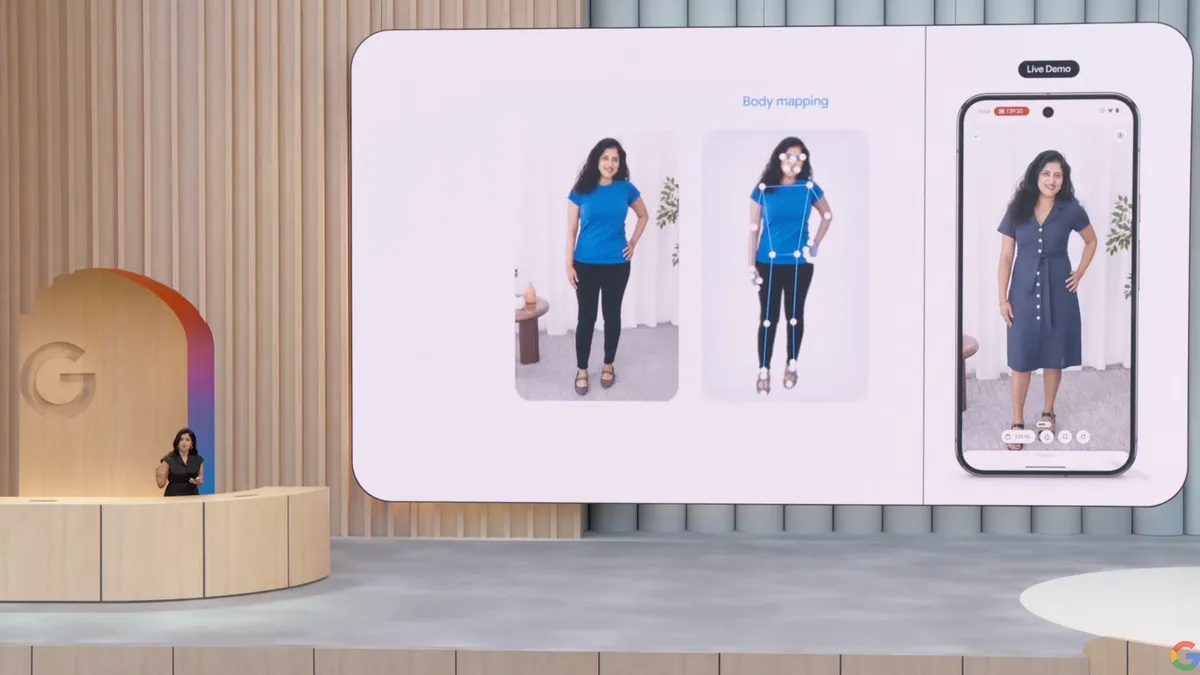
An AI fashion tool wasn’t on my Google I/O bucket list. At Google’s annual I/O developer conference, the company introduced a number of Gemini AI updates, many of which are coming to Search and, most notably, to our online shopping experiences. The new AI shopping feature lets you virtually ”try on” different pieces of clothing by taking a photo of your body and imagining how it might look on you.
Google built a custom image generation model to power its new feature. It’s a simple idea: Google’s AI takes an input image of your body and an input image of the garment and combines them. The actual process behind it is certainly more complicated. But in the live demo, it seemed to work flawlessly. The virtual try-on feature is available today in the US, with more visual shopping and AI agent updates coming soon.
I was very intrigued when I saw the live demo. I shop online for almost everything I need, and I’ve been fooled many times by misperceiving how clothes I see on models would look on me. But I’m an AI reporter, and I spend a lot of time worrying about the privacy implications of image and video tools, so I was also skeptical.
I reached out to Google after the keynote to ask about the privacy policy surrounding this new feature. A Google spokesperson said, ”Your uploaded photo is never used beyond trying things on virtually, nor is your photo used for educational purposes. It’s not shared with other Google products, services, or third parties, and you can remove or replace it at any time.”
I was stunned, but pleasantly surprised by this. In an age of AI, tech companies are typically so data-hungry that a data source like this seemed like a no-brainer for Google to tap into. Google spent a decent chunk of time at I/O showing off its new AI image and video tools, and human-generated photos like these would be useful for future model enhancements.
Tech and fashion companies have been trying to work on this problem for years — my tech-savvy colleague Katie Collins wrote about a dress-sizing app way back in 2012, and Amazon integrated AI into its fashion sales in recent years.
This model, as Vidhya Srinivasan, Google’s vice president and general manager of ads and commerce, called it during the keynote, has ”a deep understanding of the human body.” We’ll have to test it to see if it really works for all body types and sizes. AI image generators, especially early ones from Google, aren’t always great when it comes to diversity. But I’m willing to give Google a chance because it says it won’t use my images to automatically train its AI models.
As much as I want to believe that Google has given us a 2025 version of Cher’s wardrobe from Clueless, I’m still a little skeptical. There’s no guarantee that the AI version of yourself that Google generates will actually reflect how the clothes look on you in real life. But maybe this is a potentially good use of AI, instead of filling the internet with slop.